
You have changed your mind hundreds of times. The truth of two plus two has never changed once.
That difference matters.
Claim in one line: Unchanging truths exist, they outrun every private mind, and their only adequate home is in an unchanging, perfect Mind. That is God.
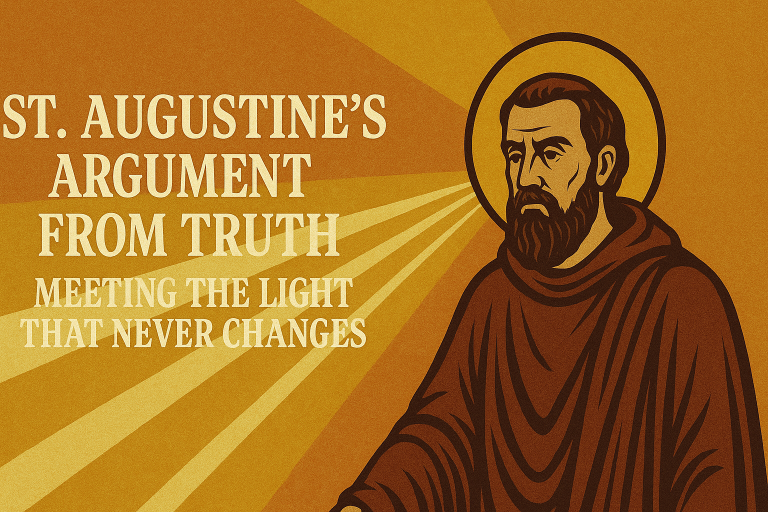
This is St. Augustine’s Argument from Truth. He noticed that some truths are not local, not trendy, not adjustable. They are timeless, necessary, and authoritative. Then he asked the daring question: Where do such truths live?
In Plain English
Augustine’s insight is simple. Your opinions move. Certain truths do not. If there are truths that hold always and everywhere, they need a ground that is not subject to time, decay, or ignorance. Matter cannot do that. A finite mind cannot do that. Only an eternal, perfect Mind can be the home of truth itself.
- Some truths are necessary: triangles have three sides, nothing can be red all over and green all over in the same respect at the same time.
- These truths are not physical: you can weigh a rock, not the law of non‑contradiction.
- They are normative: they tell your mind how it ought to think.
- Best explanation: there is a living, unchanging Truth that grounds all true judgments. Christians name this Truth as God.
Augustine’s favorite image: God is like the sun for the eyes of the mind. You see because you are in His light.
How this fits our bridge
We have been adding planks that carry weight: cosmological, modal, transcendental, intelligibility. Truth is a plank that also feels like a handrail. If you trust any discipline that trades in proof and evidence, you already lean on truths that stand above eras and opinions. Augustine simply follows that lean to its destination.
- The bridge needs stable anchors or it sways into nothing. Immutable truths supply those anchors.
- If such anchors exist, there must be something immutable that holds them.
The core claim in three moves
1) There are truths that do not change
You can discover them, ignore them, love them, or fight them. They do not move with you.
- Mathematics and logic.
- Basic moral insights like “justice is better than injustice.”
- Metaphysical necessities like “a cause cannot produce what it does not in some way contain.”
2) These truths outrun every private mind
No person invented them. Even if no one were thinking, “seven is prime unless composed of smaller integers” would still be correct.
If all minds disappeared, would the truth of two plus two equal four vanish or remain? Augustine says it would remain, which means it is not hostage to us.
3) The most fitting home of such truths is a perfect Mind
Truth has a “mind‑ish” quality. It is about what is the case, it binds thought, it instructs reason. Abstract objects are not rulers. Matter is not a teacher. A perfect, unchanging Mind can both house necessary truths and give them living authority.
- If truth lives only in finite minds, it would inherit their limits.
- If it lives in no mind, it becomes a mute museum with no bridge to knowers.
- If it lives in the divine Mind, it is both real and authoritative, and our access to it is no surprise.
Pictures to keep in mind
- Sun and sight: your eyes do not create light, they receive it. Your mind does not create truth, it recognizes it in the light of the Truth.
- Carpenter’s square: a perfectly straight edge lets you judge every cut. The square does not bend to your board, your board bends to the square.
- Compass and north: you can be confused, but north does not wobble with your confusion.
Augustine calls the experience of grasping truth a kind of illumination. It is not magic. It is what it feels like when the mind meets what is higher than itself.
For Sensors (hands‑on tests)
Try these with real things in your world.
- Ledger check: balance your budget. You trust arithmetic that does not flex when you wish it would.
- Level and line: put a level on a shelf. The bubble does not flatter you, it corrects you.
- Calendar promises: if you owe a friend money on Tuesday, the duty remains on Wednesday. Moral truth presses the same way across time.
Daily life treats truth like something we discover, not something we vote into being.
For Intuitives (the coherence picture)
You sense that truth has majesty. It summons humility and joy. It feels personal without being private, public without being cold. That is because, on Augustine’s view, Truth is not a bare idea. Truth is the radiance of a living Mind.
- The beauty of a proof, the rightness of confession, the peace that follows clarity.
- These are signs that truth is not a pile of facts, it is participation in the life of the One who is Truth.
The more deeply you know, the more you feel known.
A compact sketch (for the logically minded)
- There exist truths that are necessary, universal, immaterial, and normative.
- Such truths are not grounded in changing material processes or in any finite mind.
- Truths of this kind fit best if there is an unchanging, perfect Mind in which they subsist and from which they have authority.
- God is that Mind and that Truth.
Therefore: the existence of immutable truth supports the existence of God.
Common objections and clear replies
Objection 1: Truth is just what our community agrees to say.
Communities change. If truth follows the vote, yesterday’s geometry would be false today. Also, the claim “truth is only agreement” presents itself as a truth you should accept even if you do not agree. That is self defeating.
Objection 2: Abstract objects exist on their own, no God needed.
Abstracta cannot love, command, or illuminate. Even if numbers exist, you still need to explain why finite minds reliably contact them and why they carry oughtness for thought. A living, perfect Mind explains both access and authority.
Objection 3: Evolution made our brains track useful regularities, finished.
Usefulness is not the same as necessity. Survival pressure might favor quick heuristics, not necessary and universal insight. Yet we grasp timeless proofs that outrun utility. Mechanisms of belief do not equal grounds of truth.
Objection 4: If truths are in God, could God make two plus two equal five.
No. Augustine’s answer is that God does not invent truth by fiat, God is Truth. Arithmetic flows from the divine nature. Asking if God could make two plus two equal five is like asking if the sun could make darkness by shining more sunlight.
Objection 5: Some truths are contingent, like “Caesar crossed the Rubicon.”
Agreed. Augustine’s focus is on immutable truths, which are enough for the argument. Contingent truths still point past us, since their truth does not depend on our say‑so.
Objection 6: Why think truth needs a mind at all.
Truth is about what is the case, it is inherently of and for intellect. Strip mind from truth and you have a mannequin labeled “is the case,” with no living relation to knowers and no normativity. The category itself points home.
Lived examples where Augustine is quietly right
- You correct a calculation and feel relief. That relief is the soul’s yes to something higher than preference.
- You apologize and mean it. The confession bows to a standard you did not write.
- You teach a child that lying is wrong and expect the claim to hold when you are not in the room.
We live as if Truth judges us, not the other way around.
A note on scope
Augustine’s argument does not replace other planks. It steadies them. It says that when you reason or repent or teach, you are not floating. You have stepped into a light that was shining before you arrived and will still shine when you are gone.
Final thoughts
You have met truth many times. In a clean proof. In a hard confession. In a dawning clarity that felt like sunrise behind your eyes. Augustine’s point is not that you should now strain to see something exotic. It is that you should recognize the royalty you have already met.
If Truth corrects you, frees you, and delights you, consider that you are standing before Someone, not something.
The mind was made for this meeting. That is why it feels like coming home.