
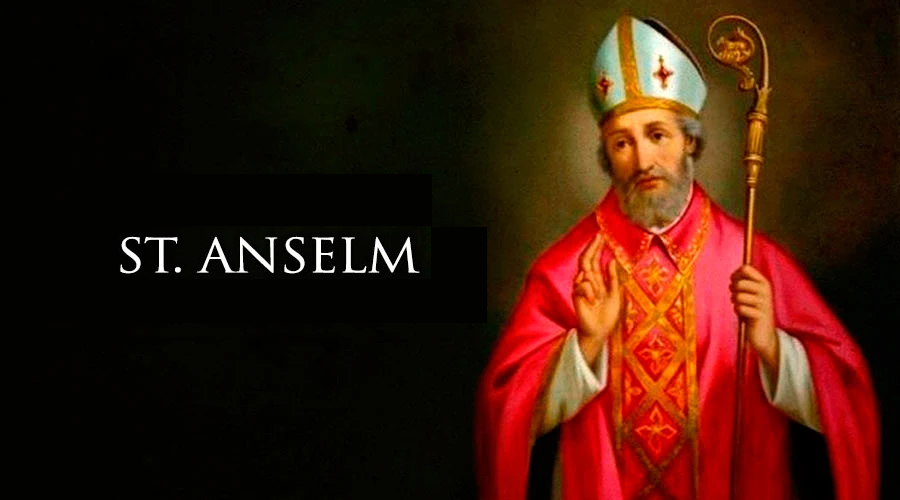
Why a medieval monk thought God’s existence follows from the very idea of God
We’re going to pause and look at one big claim. It’s tight. It’s logical. And if it lands, it lands hard.
What do we mean by “God”?
When we say God, we mean the greatest possible being. Not just strong, but all‑powerful.
Not just smart, but all‑knowing.
Not just good, bu perfectly good.
Now let’s ask a simple question.
Is a being that exists in reality greater than a being that exists only in your imagination?
Of course. Daydreaming of million dollars is nice, but having a bank account with a million dollars is better.
Now suppose “the greatest possible being” existed only in your mind.
You could still imagine something greater, a greatest possible being that actually exists.
That would make your first idea not the greatest. That’s a contradiction.
So if “God” means the greatest possible being, then God exists in reality, not just in thought.
Otherwise the very idea unravels.
Here is another way of saying it
- “The best video game ever made” that doesn’t exist…isn’t the best.
- To be the best, it has to be real.
Anselm says the same about God.
Why this matters
Faith isn’t only about microscopes and cameras. Some truths are reached by reasoning as well as by evidence. This argument is one plank in the bridge, an intellectual reason to take God seriously before you ever open a history book or look through a telescope.
- If you lean Sensor: this is not a lab sample. It’s a logic proof. Treat it like math, check the steps.
- If you lean Intuitive: this is about coherence. Does the idea of “the greatest possible being” force reality a certain way?
Both are welcome. Both are needed.
Common traps to avoid
- Trap for Sensors: “If it isn’t on video, it isn’t real.” You trust pilots, spouses, and passwords without seeing every fact firsthand. Logic is also evidence, of a different kind.
- Trap for Intuitives: “It feels elegant, so it must be true.” Don’t outrun the details. Make sure each step actually follows.
Three common objections, and three rebuttals
1) Objection: “You can’t define things into existence.”
“By that logic I can define the greatest unicorn, and poof unicorns exist.”
Reply: Unicorns are contingent things, there’s no ceiling called “maximally unicorn.” You can always add a beachier island, a greener pasture, a horn with more sparkle. There’s no natural maximum.
But the concept of God uses perfections with clear logical ceilings: all‑knowing (you can’t be “more than all”), all‑powerful (within what’s logically possible), perfectly good. That package includes necessary existence, not “exists by accident,” but “cannot fail to exist.” You can’t parody “necessary being” with “necessary island” because islands and unicorns don’t have that kind of greatness.
2) Objection: “Existence isn’t a property.” (Kant’s critique)
“You can’t add ‘exists’ to a list of traits and make something real.”
Reply: Anselm isn’t adding a cute sticker to an idea. He’s saying the greatest possible being would have a way of existing that’s better than “might or might not exist.” Call that necessary existence. It’s not a new color; it’s a different mode, like the difference between a triangle that must have three sides versus a doodle that accidentally looks triangular. Modern versions make the point this way:
- If it’s possible that a maximally great (necessarily existing) being exists, then such a being exists in some possible world.
- If it exists in some possible world necessarily, it exists in every possible world, including ours.
3) Objection: “Maybe ‘greatest possible being’ is incoherent.”
“What if omnipotence and omniscience clash? Maybe the idea breaks.”
Reply: Press the definitions, not the caricatures. “Omnipotent” doesn’t mean “can do the logically impossible” (like making a square circle). It means “power over all possible things.” When you trim away nonsense tasks, the alleged contradictions fade. If the core set of perfections is coherent, then the argument goes through. So the real work is asking whether the concept is logically clean. not whether it fits a joke puzzle.
How this fits your bridge of faith
- For the Sensor: Treat this like a proof you can audit. One premise at a time. If each step holds, you’ve laid a plank. Then add the other planks, history, documents, changed lives.
- For the Intuitive: Let the pattern click. If “God” as the greatest possible being is coherent, and if existence belongs to that greatness, the picture pulls into focus.
This argument won’t give you a lab photo of God. It gives you a logical pressure: either the concept is incoherent, or God exists. If the concept holds, you have inched closer across the chasm.
When you’re ready for the next lesson, CLICK HERE.